Part 1 set out the idea: genes and memes as two sources of pressure on one brain, the four players Genetic layer — Inherited, fixed programs: Panksepp's seven affective systems — SEEKING, FEAR, RAGE, LUST, CARE, PANIC/GRIEF and PLAY., Memetic layer — The network of everything you have learned — your memeplex. In the brain, it lives in assemblies of cells in the cortex., Interface / immune filter — The mechanisms that stand between drives and memes: they redirect, suppress or reinterpret, and filter out information that does not fit. and Substrate — The physical medium the system runs on — neurons and neurotransmitters in a brain — together with its senses, the channels through which information comes in., and the self-model. This part applies that idea to everyday experience: conversation, the birth of ideas, memory, growing up, emotion, bias, humour, sleep, mental health and culture.
How to read this part. Each section shows how Biomemetic Consciousness (BMC) — The theory this guide is about: consciousness as the interaction of four components — G (genes), M (memes), I (the mind's immune filter) and S (the substrate). In the academic papers the letters stand for Biomemetic Complex. interprets a familiar phenomenon. These are interpretations consistent with the theory, not confirmations of it. Most of these phenomena were known long before BMC, and fitting a known fact is much weaker evidence than predicting a new one. Where BMC makes a testable prediction, we say so; the six bets are the predictions it has committed to test against named rivals. All of them are commitments, not results. Where other researchers got there first, we name them. A reference list is at the end.
1. Why You Can’t Stop Talking About Your Interests
Why do experts find it so hard to stop talking about their field? The usual answer is social: we share to bond, to impress, to help. BMC adds a second layer. In BMC’s account, ideas themselves push to be expressed, a pull the theory calls Replication Expression pressure (R_expr) — The pull a meme exerts to be expressed outward — why you can't stop talking about what interests you. It is stronger for memes that are active, relevant and well connected.; below we call it the expression drive for short.
The reasoning treats meme — A unit of cultural information — a melody, a recipe, a skill, a belief — that passes from mind to mind. The term was coined by Richard Dawkins in 1976. as replicator — Anything that makes copies of itself; genes are the textbook case. How close the passing-on of ideas comes to true copying is a matter of degree; BMC treats it as a quantity to be measured, not as a settled position., the copying end of the scale described in Part 1; how close real transmission comes to that end is still to be measured. If memes spread through communication, the ones that best get themselves said will spread most. In BMC’s model the push is strongest for ideas at the centre of your network, the hubs connected to most of what you know. On that reading:
- Experts keep returning to their speciality because it sits at the centre of their knowledge.
- You steer conversations back to your favourite topic because its ideas compete for your voice.
- Evangelists and activists often describe feeling compelled to spread a message that sits at the centre of their identity.
The expression drive competes with curiosity, the SEEKING — One of Panksepp's seven affective systems: exploration, curiosity, the appetite for the new. Powered by dopamine. system, for the same channel. In “listen mode” curiosity dominates and you want to take things in. In “share mode” the expression drive dominates and you need to talk. Good conversations switch between the two. Being lectured at satisfies the speaker, whose central ideas get out, and leaves the listener flat, because their own open questions are never touched.
2. How Ideas Are Born (And Why Some Die Young)
What happens when a new idea forms in your head? BMC describes two quite different routes.
| Path 1: the flashbulb | Path 2: slow crystallisation | |
|---|---|---|
| Trigger | A surprise that matters emotionally: something your knowledge didn’t predict | The same pattern, met again and again |
| Speed | Seconds | Days to months |
| How it feels | One vivid, emotionally charged moment | No single moment; one day you simply know how |
| Typical content | Shocking news, a near-miss, a frightening event | Vocabulary, skills, habits, tastes, social norms |
| Example | Remembering where you were when you heard terrible news | A guitar chord your fingers find without thinking |
Path 1 is fast and emotional. Surprise plus emotional weight puts an experience on a fast track into long-term memory. Such memories feel permanent and precise, but research on “flashbulb memories” shows that their details drift over the years while confidence stays high (Talarico & Rubin, 2003). The memory section below returns to why. In BMC’s reading, traumatic memories can form by the same route: a very large surprise carrying an extreme emotional charge.
Path 2 is slow. When the same region of experience is activated over and over, a stable idea gradually forms, like a footpath worn across a field by many walkers without anyone deciding to make it. Most everyday knowledge forms this way.
Why Some Ideas Die Young
A newborn idea is fragile: it has few connections and is easily lost. If it isn’t revisited, it fades within hours or days. In BMC’s account, survival depends on three things: emotional significance; compatibility with what you already believe (passing the I-layer, the mind’s filter on incoming ideas); and how often the idea is reactivated. That fits familiar observations. Cramming works for tomorrow’s exam but not for next year. Advertisers rely on repetition. Spaced practice beats massed practice. A frightening day stays with you while ordinary days blur together.
3. Memory: Recording, Remixing, Forgetting
BMC treats memory less as a filing cabinet and more as a living network that is constantly rewritten. Three processes matter.
Consolidation. A new idea moves from a fragile first impression to short-term and then long-term storage. Reactivation, emotional weight and a good fit with existing knowledge speed the move. That is one reading of why you remember your first kiss but not what you had for lunch three Tuesdays ago.
Working memory. Your Working Memory (WM) — The small mental workspace holding what you are thinking about right now: about 3–4 items in focus, roughly 7 ± 2 counting those held in the background. In BMC, genes and memes compete for this space. is the set of ideas “lit up” right now. Psychologists have long known that people hold only a handful of items at once: Miller’s (1956) “seven, plus or minus two”, later revised by Cowan (2001) to about three or four items in the focus of attention. BMC offers an account of how both numbers can hold. About three or four ideas are fully active. Another three or four were active a moment ago and can be brought back by a light cue, building on the synaptic theory of working memory, in which recently active items are held without ongoing neural activity (Mongillo, Barak & Tsodyks, 2008). Four plus three gives the familiar seven. On this account, seven is not a built-in constant but the sum of two separate mechanisms.
Reconsolidation. This is the most surprising of the three. When you recall a memory, it becomes editable for a while before it is stored again; this was demonstrated influentially for fear memories in rats (Nader, Schafe & LeDoux, 2000), reviving much older observations. Recall reconstructs rather than replays, and the context of recall can change what goes back into storage. BMC builds reconsolidation — When a memory is recalled it becomes briefly changeable and is then stored again, sometimes altered (Nader, Schafe & LeDoux, 2000). into its model of memory. It is consistent with why memories drift, why eyewitness accounts are unreliable, and why some therapies revisit a painful memory in a safe setting: the hope is that it is stored again with a weaker emotional charge.
BMC adds one condition of its own. When the recall is triggered by a new idea that clashes with the memory, the idea filter decides first. If it rejects the newcomer, the old memory stays as it was: it is neither reopened nor strengthened. BMC does not predict a reverse (“backfire”) effect, which replicates poorly in people. If the filter accepts the newcomer, the old memory is pushed aside while the new idea is active. Only when the filter stays neutral does the size of the surprise decide what happens to the memory.

Forgetting as Feature
BMC treats forgetting as useful, and distinguishes two kinds.
Passive decay. Unused ideas slowly fade, which frees resources. That is why the name of someone you met once at a party is gone.
Active suppression. Recalling one item suppresses its close competitors, a well-documented effect called retrieval-induced forgetting (Anderson, Bjork & Bjork, 1994). It works like a search engine pushing down near-miss results so the right one comes up fast. The side effect is that a useful memory stored next to the one you retrieved can be suppressed too.
4. Growing Up: How Consciousness Develops
In BMC’s picture, a baby is not a small adult with an empty hard drive. It is a different kind of system: one run almost entirely by the genetic layer, with very few memes yet. BMC describes development as five overlapping stages. The ages are rough guides taken from developmental psychology, not boundaries set by the theory. “Self-model level” refers to the three levels in Part 1: 0 = body awareness, 1 = self-knowledge, 2 = metacognition, thinking about one’s own thinking.
| Stage | Rough age | What appears (BMC’s reading) | Self-model level |
|---|---|---|---|
| 1. Mostly genetic | birth to ~6 months | Inborn emotional systems (SEEKING, FEAR, PANIC/GRIEF, CARE); bodily sensations; basic preferences | 0 |
| 2. First memes | ~6 months to ~2 years | Repeated experiences crystallise (faces, sounds, routines); object permanence; almost no filter on incoming ideas | 0 |
| 3. The self-model appears | ~2 to 5 years | “I want”, “Mine!”; mirror self-recognition (typically around 18–24 months, at the boundary with the previous stage); embarrassment, pretend play | 1 |
| 4. The filter matures | ~5 to 12 years | The I-layer strengthens; “my group” versus “other groups”; stable preferences; many biases settle in; working memory grows | 1 |
| 5. Thinking about thinking | adolescence | Questioning one’s own identity; imagining other possible selves | 2 |
Three points are worth drawing out.
Early childhood has almost no filter. In BMC’s account the I-layer is barely formed in the first years, so infants take in language, norms and emotional patterns with little filtering. That is one interpretation of why early experience has such lasting influence.
The self-model switches on at a threshold. BMC describes its onset as a threshold-like transition: once enough ideas about the self accumulate, the system starts modelling itself. Where exactly that threshold lies has not been measured. Children raised with very little human contact are sometimes cited as consistent with this picture: an intact brain and inborn emotional systems, almost no cultural input, and lasting limits on language and self-reflection. They are weak evidence, though, because such cases usually also involve severe neglect, abuse or possible prior disability.
Adolescence is a recursive shock. When the level-2 self-model comes online, a teenager can think about their own thinking, and the recursion exposes contradictions: “Am I who my parents think I am? Who my friends think I am? Who am I really?” BMC suggests that the intensity of this crisis depends on how fast new cultural input arrives relative to how mature the filter is. That is a hypothesis, not a finding. Whether smartphones and social media harm adolescent mental health is an active and unsettled research debate.
5. Emotions: Your Ancient Operating System
BMC’s genetic layer is built on the seven core emotional systems described by the neuroscientist Jaak Panksepp — Neuroscientist who described seven core emotional systems shared by mammals — SEEKING, FEAR, RAGE, LUST, CARE, PANIC/GRIEF, PLAY (Affective Neuroscience, 1998). BMC uses them as its G layer. (1998): SEEKING, FEAR, RAGE, LUST, CARE, PANIC/GRIEF and PLAY. In BMC each of them is more than a feeling. It is an operating mode that changes how you think. Take FEAR and PLAY in BMC’s model:
| FEAR | PLAY | |
|---|---|---|
| Working memory | Takes up a slot: one fewer idea you can hold | Takes up none |
| What gets through | Only strong signals (tunnel vision) | Weak signals too (broader attention) |
| Associations | Narrow: fewer creative links | Wide: more creative links |
| Pace | Fast, even if rough | Slower and exploratory |
The general pattern is old news: attention narrows under threat (Easterbrook, 1959), and positive emotions broaden thinking (Fredrickson, 2001). BMC’s addition is a specific mechanism, FEAR occupying a working-memory slot while PLAY occupies none, and that version can be tested. It is one of the six bets.
BMC also places each system on a map of pleasant versus unpleasant (valence) and calm versus aroused (arousal).
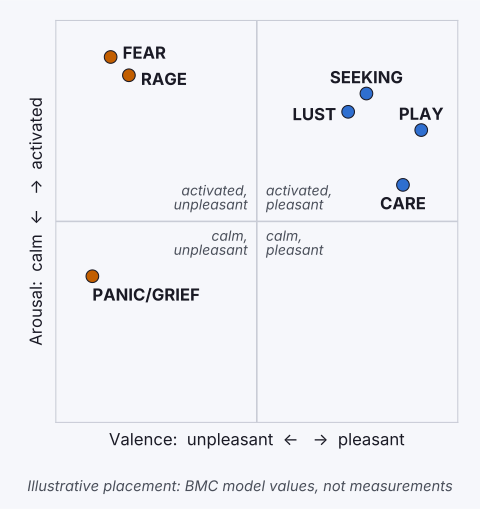
This touches a long-running debate. Panksepp treated emotions as distinct inborn circuits. Constructionists such as Lisa Feldman Barrett (2017) argue that emotions are built from more basic ingredients such as valence and arousal. BMC’s position is that the two views describe different levels. At the genetic level, each system is a distinct circuit with its own chemistry. At the level of experience, shaped by culture, we feel blends along a continuous space. Proponents of either view need not accept this split; it is BMC’s proposal, not a settlement of the debate.
6. Why We’re All Biased (And It’s Not Just a Bug)
Psychologists have catalogued roughly two hundred cognitive biases. A common view treats them as flaws to overcome. Others have tried to unify them, for example as belief-consistent information processing (Oeberst & Imhoff, 2023) or as sensible solutions under limited resources (Lieder & Griffiths, 2020). BMC joins these attempts with its own proposal: biases are side effects of six mechanisms, each of which does useful work. Read the table from left to right. Each mechanism produces its biases, not the other way round.
| Mechanism | What it does for you | Biases it can produce |
|---|---|---|
| Hub inertia | Keeps core beliefs, and identity, stable | Confirmation bias, belief perseverance |
| Idea filter (the I-layer) | Defends your worldview against hostile or junk ideas | In-group bias, hostile media effect |
| Working-memory limits | Lets you act with only three or four items in focus | Anchoring, framing effects, base-rate neglect |
| Emotional capture | Lets urgent emotions take priority | Loss aversion, affect heuristic |
| Automatisation | Runs well-practised behaviour without effort | Status quo bias, functional fixedness |
| Reconsolidation | Keeps memories updated with new information | Hindsight bias, misinformation effect |
Two examples. Your core beliefs are hubs, connected to much of what you know. Revising one would ripple through everything, so the network resists, and that resistance feels like being right. And because every recall re-stores a memory, once you learn how something turned out you may “remember” having seen it coming.
The practical upshot, on this view, is that a bias can’t simply be removed without weakening the function behind it. Confirmation bias is the price of a stable identity: switch it off entirely and every new piece of information could reorganise your beliefs. A more useful goal is to recognise which mechanism is at work and compensate for it. This is a proposed mapping, not an established taxonomy. Whether six mechanisms really account for the whole catalogue is an open empirical question.
7. Why Things Are Funny
Humour looks frivolous, but BMC treats it as a small window into how the mind works. The core idea is old. Arthur Koestler called it “bisociation” (1964), and psychologists formalised it as incongruity followed by resolution (Suls, 1972). BMC restates it in its own terms.
The Setup-Punchline Mechanism
The setup creates an expectation: your knowledge predicts where the story is going. The punchline reveals a second path that also fits but leads somewhere unexpected. In BMC’s terms, the setup opens a small gap, a brief dose of Structural Incompleteness Tension (SIT) — Tension created by gaps in what you know. Above a threshold it switches on SEEKING; it is felt as curiosity, unease or the sense of unfinished business. (Structural Incompleteness Tension, the pull of a missing connection; see Part 1). The punchline closes it by a route you didn’t see coming.
This leads to a testable prediction: humour and insight are one mechanism running at different speeds. The “ha!” of a joke closes the gap before deliberate thought catches up. The “aha!” of a solved puzzle closes it afterwards. If that is right, the two should share brain machinery; BMC points to the anterior cingulate and medial prefrontal cortex. Like BMC’s other predictions, this is a commitment, not a result.
Why Jokes Stop Being Funny
The second time you hear a joke, the punchline no longer surprises you, so there is no gap to close. BMC predicts that the loss is steep at first and then levels off: the biggest drop comes between the first and second hearing (exponential rather than linear decay).
Why Humor Requires Knowledge
Without relevant knowledge there is no expectation, and without an expectation there is nothing to subvert. Physics jokes need physics. In-jokes need the group’s shared knowledge. Children’s humour starts simple and becomes more layered as their knowledge grows.
The Social Function
On this reading, shared laughter signals overlapping knowledge: two people noticed the same gap and the same unexpected way to close it. That is one interpretation of why laughing together bonds people, and why missing a joke can create distance.
8. Altered States: Sleep, Dreams, Flow, Psychedelics
BMC reads each state of consciousness as a different setting of the three factors behind the Consciousness Level (CL) — BMC's proposed single number for how conscious a system is at a given moment. It combines how the network is organised, how active the self-model is, and the balance between genes and memes. described in Part 1: how integrated the network is, how active the Self-Model Cluster (SMC) — The part of the memeplex that models the system itself, on three levels: the body, the life story (the narrative self), and thinking about one's own thinking. is, and how balanced the gene–meme tension is.
Sleep and Dreams
Deep (NREM) sleep. Integration drops. This is consistent with brain-stimulation studies showing that a signal stops spreading across the cortex in deep sleep (Massimini et al., 2005), with similar findings under some anaesthetics (Ferrarelli et al., 2010).
REM sleep and dreaming. Integration partly returns, but in BMC’s model the I-layer, the idea filter, is weakened. Ideas recombine without the usual checks: your late grandmother can drive a spaceship through your office and nothing objects. On waking the filter is back, and the absurdity is obvious. The dream hasn’t changed; your ability to judge it has. A weaker filter could also allow unusual but useful connections. That fits, but does not prove, the many anecdotes of ideas arriving in dreams.
Recurring dreams. In BMC’s reading, these circle an unresolved gap: an open tension that is reactivated each night and recombined differently, until it is resolved in waking life.
Lucid dreaming. The self-model partly comes back online while the rest of the brain stays in dream mode. That fits reports of increased frontal activity around 40 Hz during lucid dreams (Voss et al., 2009), and the way lucid dreamers describe the state as unlike both waking and ordinary dreaming.
Flow State
Flow (Csikszentmihalyi, 1990) looks paradoxical: peak performance together with a sense of effortlessness and lost self-awareness. BMC’s reading separates two things:
- Reflexive consciousness: awareness of yourself as the one acting (the self-model is in view);
- Operative consciousness: how well information is being processed (integration and balance).
In flow, reflexive consciousness drops, because the self-model keeps running but becomes transparent, while operative consciousness stays high. You are not less conscious, but differently conscious: the self becomes a window rather than a mirror.
Psychedelics: The Inverted U
A naive “integration-only” reading of consciousness would say that if psychedelics increase brain integration, more drug means more consciousness. That reading is a simplification, not a position we attribute to any particular theory, and its premise is itself debated: the “entropic brain” work of Carhart-Harris and colleagues (2014) describes psychedelic states in terms of increased disorder in brain activity rather than simply more integration.
BMC instead predicts an inverted U across dose:
- Low dose: integration rises and the self-model stays intact. The result is heightened awareness, vivid perception and deep reflection. By BMC’s measure, consciousness rises.
- High dose: the self-model dissolves (“ego dissolution”), leaving no stable “you” to have the experience. By BMC’s measure, consciousness falls, because the theory ties consciousness to the self-model.
This fits a common pattern in reports, with low doses described as “more aware” and high doses as dissolving into something profoundly meaningful but not like being “more you”. First-person reports vary widely, though, and the prediction is a commitment, not a result.
9. Mental Health Through the BMC Lens
Conceptual model, not clinical guidance. This section describes how BMC’s model represents mental-health conditions. It is a theoretical sketch, not a diagnostic tool or treatment advice, and it has not been clinically tested. If you are struggling, please talk to a qualified professional.
BMC proposes treating conditions not as separate boxes but as regions in a continuous space of parameters. It shares that idea with dimensional approaches in psychiatry such as RDoC (Insel et al., 2010) and HiTOP (Kotov et al., 2017). Picture a panel of sliders: how integrated the network is, how strict the idea filter is, how much working memory is free, which emotional system dominates, how stable the self-model is, and how automatic behaviour has become. In the model, certain sliders far from their usual range correspond to recognisable profiles.
| Condition | Model sketch | In plain language |
|---|---|---|
| Depression | Low integration; PANIC/GRIEF dominant; SEEKING and PLAY low | Less like sadness, more like the network going quiet: curiosity, joy and positive memories become hard to reach |
| ADHD | Unstable integration; SEEKING overactive | Many curiosity gaps open at once and are closed too early, which opens new ones |
| PTSD | FEAR stuck; a traumatic memory resists being re-stored in a calmer form | One frightening experience becomes a central hub that won’t fade and keeps claiming working memory |
| OCD | Filter overactive; a gap that won’t register as closed | “Did I lock the door?” It is checked and closed, but the closure doesn’t register, so the gap reopens |
| Schizophrenia | Filter much weaker; self-model fragmented | Internal ideas pass unfiltered and can feel like outside perceptions |
| Dissociative identity disorder | Self-model split into weakly connected clusters | Different self-models are active at different times |
Autism needs separate care. Many autistic people and clinicians regard autism as a different way of processing rather than a disorder, and we do not mean to frame it as a fault. In BMC’s model, one way to describe some autistic cognitive profiles is a stricter idea filter: strong, highly structured local processing, fewer long-range links, and less weight on signals that don’t fit established patterns. This echoes older accounts of a detail-focused cognitive style (Happé & Frith, 2006), which remain debated. Autism is highly diverse, and no single parameter captures it.
The model’s main testable claim concerns comorbidity. Conditions that involve the same displaced sliders should co-occur more often than conditions that involve different ones: for example ADHD with depression (the same integration slider, pushed in opposite directions), or OCD with autism (both a stricter filter). This is a commitment, not a result. The slider positions would have to be fixed in advance and then checked against population data, and that has not been done.
10. Civilisation: When Memes Build Scaffolding
Termites build huge mounds without a plan: each deposit of material guides where the next termite builds. The biologist Pierre-Paul Grassé (1959) called this stigmergy, coordination through traces left in the environment.
Human culture works in a similar way. A path is worn by thousands of walkers. A legal system grows from thousands of disputes, each settled with an eye on earlier ones. Nobody designed English, yet millions of speakers shaped it through use. BMC calls this memetic stigmergy: the traces memes leave in the world (books, buildings, laws, institutions, online content) guide which ideas form in the next generation of minds.
Why This Matters for Consciousness
BMC proposes that as cultural scaffolding gets richer, individual minds need to carry less internally: if an answer can be looked up, it needn’t be stored. One claim sometimes cited here is that average human brain size has decreased in the recent past. Treat it as contested. One study dated a decline to about 3,000 years ago and linked it to the rise of complex societies (DeSilva et al., 2021); a re-analysis found no good evidence for that recent decline (Villmoare & Grabowski, 2022). BMC’s idea would be consistent with such a decline if it holds up. It is not evidence for BMC.
On this view, losing cultural infrastructure, such as burned libraries or collapsed institutions, costs more than information. It removes scaffolding that individual minds lean on.
The Civilisation Lifecycle
BMC also uses stigmergy to describe, speculatively, how cultures change. Young cultures have thin scaffolding, and people work most things out for themselves. Mature cultures are rich in institutions and accumulated knowledge. In declining cultures the shared scaffolding erodes, and society fragments into groups whose idea filters reject one another. In those terms, today’s split into competing online information ecosystems looks like a fragmentation event: not new in history, but unusually fast. This is an interpretive frame, not a measured result.
Your Smartphone as Extended Consciousness
Is your phone part of your mind? The philosophers Andy Clark and David Chalmers (1998) argued that, under the right conditions, an external tool such as a notebook can be part of a person’s mind: the “extended mind”. BMC puts this in its own terms. The phone is stigmergic scaffolding that stores ideas (notes, contacts, photos) and triggers them (reminders, search). When you can’t recall a fact but know exactly where to find it, the pointer lives in your head and the content lives in the device.
BMC expects a trade-off: less internal storage of easily retrieved facts, more breadth of accessible knowledge, and fragility if the device is lost. One finding is consistent with this. In a brain-imaging study, activity in the hippocampus, a region involved in navigation, tracked the number of onward street options when people planned their own route, but not when they were simply told which way to go (Javadi et al., 2017). That is a short-term effect during a task, not evidence of lasting change.
That is the idea at work. Part 3 turns to machines, to how BMC relates to other theories of consciousness, and to what is and isn’t established. For the formal versions of the ideas in this part, see the theory pages (EMT, NM, BM) and the glossary.
References
- Anderson, M. C., Bjork, R. A., & Bjork, E. L. (1994). Remembering can cause forgetting: Retrieval dynamics in long-term memory. Journal of Experimental Psychology: Learning, Memory, and Cognition, 20(5), 1063–1087.
- Barrett, L. F. (2017). How Emotions Are Made: The Secret Life of the Brain. Houghton Mifflin Harcourt.
- Carhart-Harris, R. L., et al. (2014). The entropic brain: A theory of conscious states informed by neuroimaging research with psychedelic drugs. Frontiers in Human Neuroscience, 8, 20.
- Clark, A., & Chalmers, D. (1998). The extended mind. Analysis, 58(1), 7–19.
- Cowan, N. (2001). The magical number 4 in short-term memory: A reconsideration of mental storage capacity. Behavioral and Brain Sciences, 24(1), 87–114.
- Csikszentmihalyi, M. (1990). Flow: The Psychology of Optimal Experience. Harper & Row.
- DeSilva, J. M., Traniello, J. F. A., Claxton, A. G., & Fannin, L. D. (2021). When and why did human brains decrease in size? A new change-point analysis and insights from brain evolution in ants. Frontiers in Ecology and Evolution, 9, 742639.
- Easterbrook, J. A. (1959). The effect of emotion on cue utilization and the organization of behavior. Psychological Review, 66(3), 183–201.
- Ferrarelli, F., et al. (2010). Breakdown in cortical effective connectivity during midazolam-induced loss of consciousness. PNAS, 107(6), 2681–2686.
- Fredrickson, B. L. (2001). The role of positive emotions in positive psychology: The broaden-and-build theory of positive emotions. American Psychologist, 56(3), 218–226.
- Grassé, P.-P. (1959). La reconstruction du nid et les coordinations interindividuelles chez Bellicositermes natalensis et Cubitermes sp. La théorie de la stigmergie : essai d’interprétation du comportement des termites constructeurs. Insectes Sociaux, 6(1), 41–80.
- Happé, F., & Frith, U. (2006). The weak coherence account: Detail-focused cognitive style in autism spectrum disorders. Journal of Autism and Developmental Disorders, 36(1), 5–25.
- Insel, T., et al. (2010). Research Domain Criteria (RDoC): Toward a new classification framework for research on mental disorders. American Journal of Psychiatry, 167(7), 748–751.
- Javadi, A.-H., et al. (2017). Hippocampal and prefrontal processing of network topology to simulate the future. Nature Communications, 8, 14652.
- Koestler, A. (1964). The Act of Creation. Hutchinson.
- Kotov, R., et al. (2017). The Hierarchical Taxonomy of Psychopathology (HiTOP): A dimensional alternative to traditional nosologies. Journal of Abnormal Psychology, 126(4), 454–477.
- Lieder, F., & Griffiths, T. L. (2020). Resource-rational analysis: Understanding human cognition as the optimal use of limited computational resources. Behavioral and Brain Sciences, 43, e1.
- Massimini, M., et al. (2005). Breakdown of cortical effective connectivity during sleep. Science, 309(5744), 2228–2232.
- Miller, G. A. (1956). The magical number seven, plus or minus two: Some limits on our capacity for processing information. Psychological Review, 63(2), 81–97.
- Mongillo, G., Barak, O., & Tsodyks, M. (2008). Synaptic theory of working memory. Science, 319(5869), 1543–1546.
- Nader, K., Schafe, G. E., & LeDoux, J. E. (2000). Fear memories require protein synthesis in the amygdala for reconsolidation after retrieval. Nature, 406(6797), 722–726.
- Oeberst, A., & Imhoff, R. (2023). Toward parsimony in bias research: A proposed common framework of belief-consistent information processing for a set of biases. Perspectives on Psychological Science, 18(6), 1464–1487.
- Panksepp, J. (1998). Affective Neuroscience: The Foundations of Human and Animal Emotions. Oxford University Press.
- Suls, J. M. (1972). A two-stage model for the appreciation of jokes and cartoons: An information-processing analysis. In J. H. Goldstein & P. E. McGhee (Eds.), The Psychology of Humor (pp. 81–100). Academic Press.
- Talarico, J. M., & Rubin, D. C. (2003). Confidence, not consistency, characterizes flashbulb memories. Psychological Science, 14(5), 455–461.
- Villmoare, B., & Grabowski, M. (2022). Did the transition to complex societies in the Holocene drive a reduction in brain size? A reassessment of the DeSilva et al. (2021) hypothesis. Frontiers in Ecology and Evolution, 10, 963568.
- Voss, U., Holzmann, R., Tuin, I., & Hobson, J. A. (2009). Lucid dreaming: A state of consciousness with features of both waking and non-lucid dreaming. Sleep, 32(9), 1191–1200.